

Quarterly earnings results are a good time to check in on a company’s progress, especially compared to its peers in the same sector. Today we are looking at MongoDB (NASDAQ:MDB) and the best and worst performers in the data storage industry.
Data is the lifeblood of the internet and software in general, and the amount of data created is accelerating. As a result, the importance of storing the data in scalable and efficient formats continues to rise, especially as its diversity and associated use cases expand from analyzing simple, structured datasets to high-scale processing of unstructured data such as images, audio, and video.
The 4 data storage stocks we track reported a strong Q4. As a group, revenues beat analysts’ consensus estimates by 3.2% while next quarter’s revenue guidance was in line.
In light of this news, share prices of the companies have held steady. On average, they are relatively unchanged since the latest earnings results.
MongoDB (NASDAQ:MDB)
Named after "humongous database," reflecting its ability to handle massive data loads, MongoDB (NASDAQ:MDB) provides a flexible document-based database platform that helps developers build, deploy, and maintain modern applications more efficiently.
MongoDB reported revenues of $695.1 million, up 26.7% year on year. This print exceeded analysts’ expectations by 3.7%. Overall, it was a satisfactory quarter for the company with a solid beat of analysts’ billings estimates but EPS guidance for next quarter missing analysts’ expectations.
"We delivered strong fourth quarter results driven by our continued go-to-market execution and the broad-based demand we are seeing across our product lines, as customers deploy additional elements of the MongoDB platform. At the same time, we significantly outperformed on operating margin, achieving a rule of 40 performance and demonstrating we can drive durable revenue growth while simultaneously expanding margin," said CJ Desai, President and Chief Executive Officer of MongoDB.
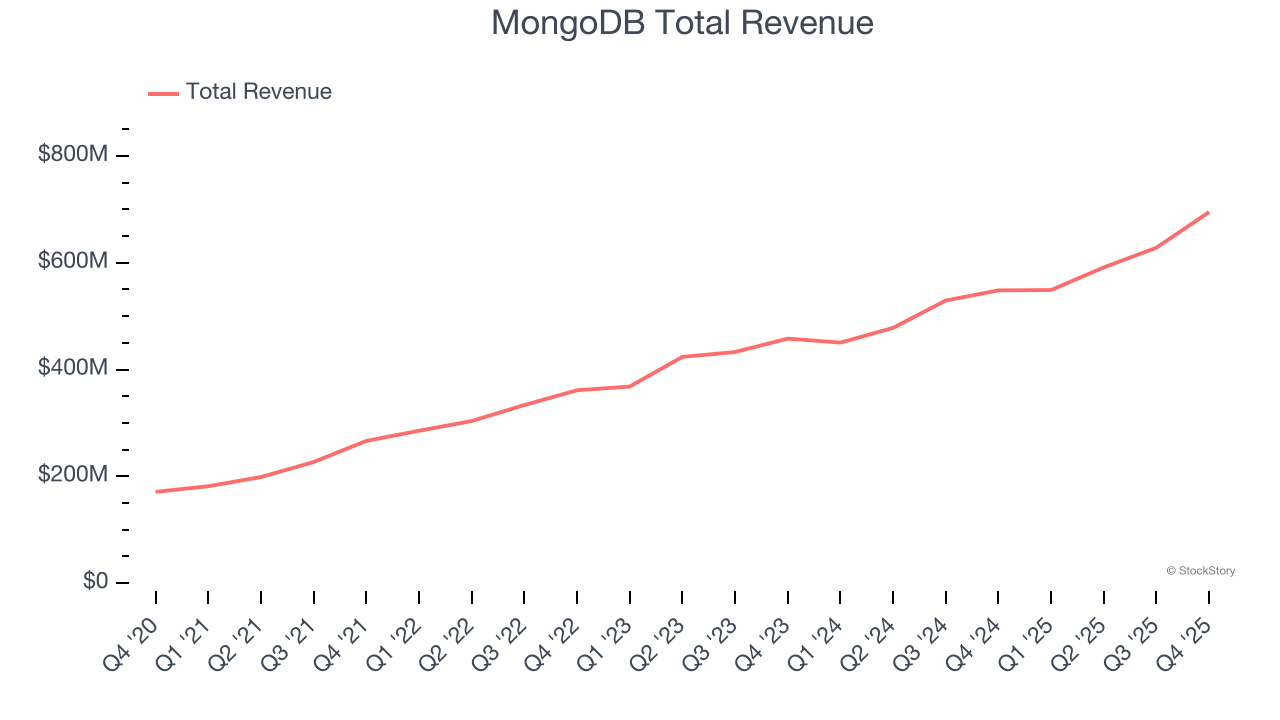
MongoDB delivered the weakest full-year guidance update of the whole group. The company added 105 enterprise customers paying more than $100,000 annually to reach a total of 2,799. Unsurprisingly, the stock is down 20.3% since reporting and currently trades at $259.
Is now the time to buy MongoDB? Access our full analysis of the earnings results here, it’s free.
Best Q4: Snowflake (NYSE:SNOW)
Named after the unique architecture of its data warehouse which resembles a snowflake pattern, Snowflake (NYSE:SNOW) provides a cloud-based data platform that enables organizations to consolidate, analyze, and share data across multiple cloud providers.
Snowflake reported revenues of $1.28 billion, up 30.1% year on year, outperforming analysts’ expectations by 2.1%. The business had an exceptional quarter with an impressive beat of analysts’ billings and EBITDA estimates.
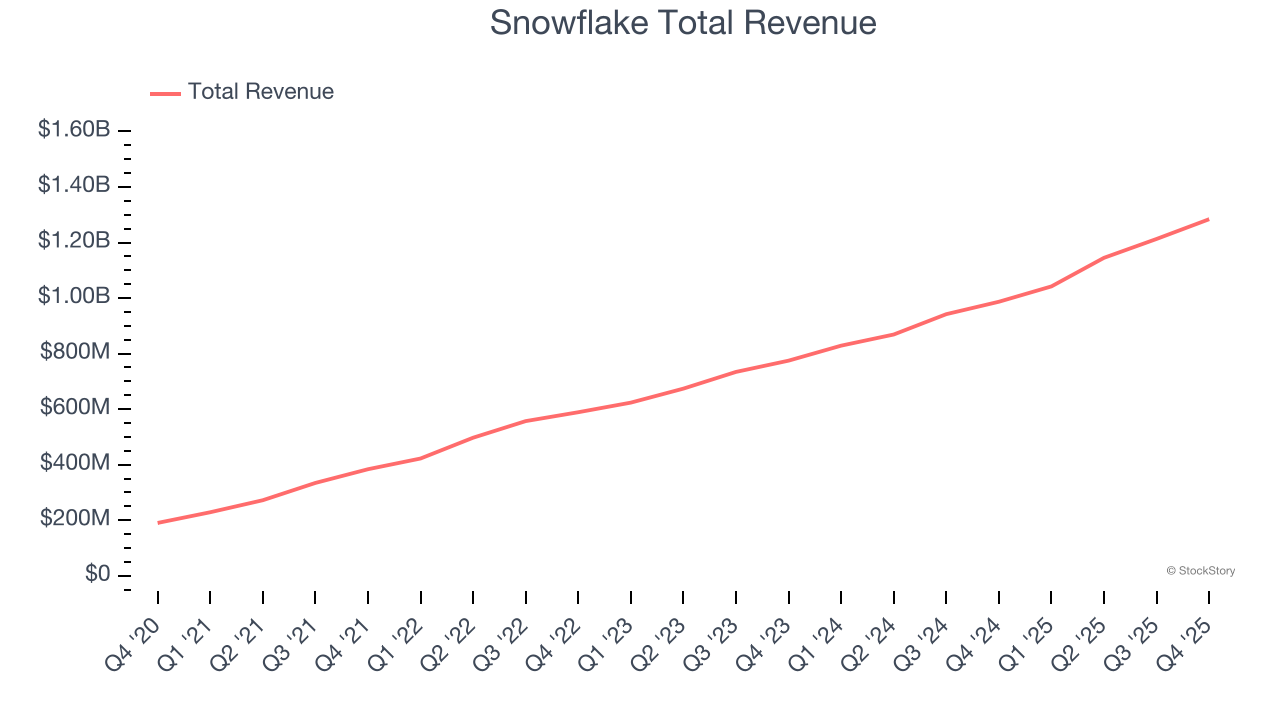
Snowflake pulled off the fastest revenue growth among its peers. The company added 45 enterprise customers paying more than $1 million annually to reach a total of 733. Although it had a fine quarter compared its peers, the market seems unhappy with the results as the stock is down 12.7% since reporting. It currently trades at $147.67.
Is now the time to buy Snowflake? Access our full analysis of the earnings results here, it’s free.
Weakest Q4: DigitalOcean (NYSE:DOCN)
Built for simplicity in a world of complex cloud solutions, DigitalOcean (NYSE:DOCN) provides a simplified cloud computing platform that enables developers and small businesses to quickly deploy and scale applications.
DigitalOcean reported revenues of $242.4 million, up 18.3% year on year, exceeding analysts’ expectations by 2%. Still, it was a mixed quarter as it posted full-year EPS guidance missing analysts’ expectations significantly.
DigitalOcean delivered the weakest performance against analyst estimates and slowest revenue growth in the group. Interestingly, the stock is up 62.2% since the results and currently trades at $96.08.
Read our full analysis of DigitalOcean’s results here.
Commvault (NASDAQ:CVLT)
Born from the need to create ironclad protection in an increasingly dangerous digital world, Commvault (NASDAQ:CVLT) provides data protection and cyber resilience software that helps organizations secure, back up, and recover their data across on-premises, hybrid, and multi-cloud environments.
Commvault reported revenues of $313.8 million, up 19.5% year on year. This number topped analysts’ expectations by 4.9%. It was a very strong quarter as it also put up a solid beat of analysts’ billings and EBITDA estimates.
Commvault delivered the biggest analyst estimates beat and highest full-year guidance raise among its peers. The stock is down 31.5% since reporting and currently trades at $88.58.
Read our full, actionable report on Commvault here, it’s free.
Market Update
Late in 2025 into early 2026, there was hand wringing around artificial intelligence. For software companies, the fear was that AI would erode pricing power and compress margins as new tools made it easier to replicate what once required expensive enterprise platforms. Crypto investors had their own version of the same anxiety: if AI agents could trade, allocate capital, and manage wallets autonomously, what exactly was the long-term value of today’s crypto infrastructure?
These concerns triggered a noticeable rotation away from these sectors and into safer havens. But markets rarely dwell on one narrative for long. Spring 2026 came, and the focus shifted abruptly from technological disruption to geopolitical risk. The US’ conflict with Iran became the dominant driver of market psychology, and when geopolitics takes center stage, the script changes quickly. Investors stop debating growth rates and start worrying about oil supply, inflation, and global stability.
Want to invest in winners with rock-solid fundamentals? Check out our 9 Best Market-Beating Stocks and add them to your watchlist. These companies are poised for growth regardless of the political or macroeconomic climate.
StockStory’s analyst team — all seasoned professional investors — uses quantitative analysis and automation to deliver market-beating insights faster and with higher quality.