
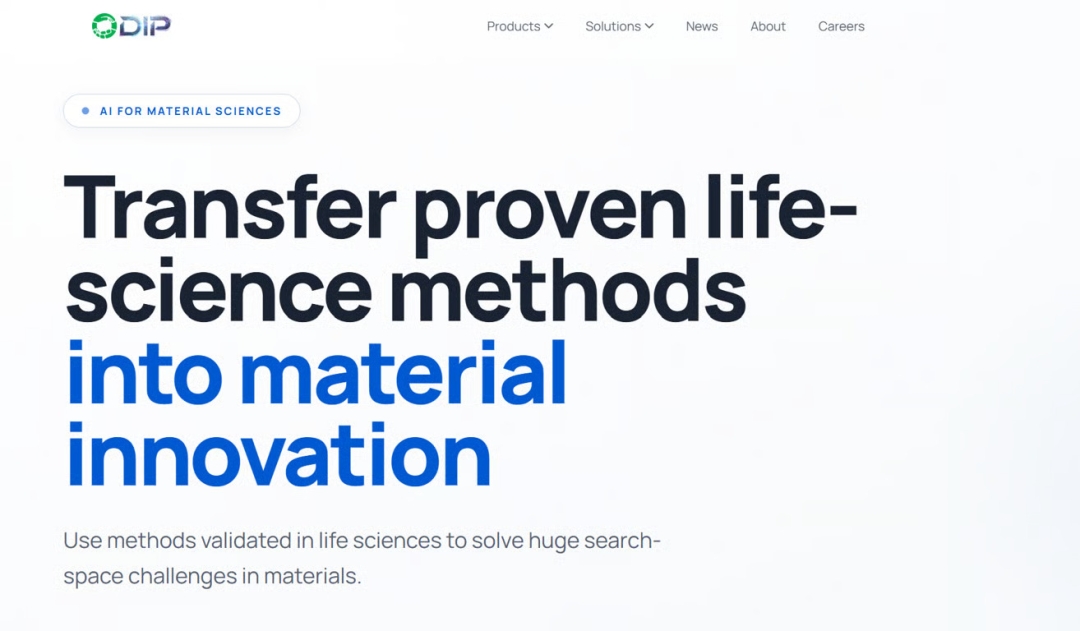
Deep Intelligent Pharma (DIP), an AI-native research and development company, is expanding its use of AI for materials science to help industrial R&D teams discover and optimize advanced materials faster.
The company’s AI for materials science platform combines artificial intelligence, scientific computing, materials informatics, and expert knowledge. It helps researchers predict material structures and properties, screen potential candidates, understand performance mechanisms, and select the most promising materials for laboratory testing.
DIP’s AI material discovery technology covers seven major fields: battery materials, semiconductor materials, agrochemicals, special alloys and coatings, polymer composites, advanced metals, and chemical catalysts.
Traditional materials research often depends on testing large numbers of chemical compositions and structures. This trial-and-error process can take 10 to 20 years, require substantial investment, and still fail to produce a commercially useful material.
DIP uses an AI-guided, design-first approach. Rather than testing every possible material combination, researchers can use AI models and scientific simulations to narrow the search space before conducting physical experiments.
“AI for materials science is not designed to replace scientists or laboratory validation,” said the spokesperson at DIP. “Its value is in helping scientists make better decisions—identifying stronger candidates, reducing unnecessary experiments, and accelerating the path from material design to commercial application.”
How DIP Uses AI for Materials Science
DIP transfers computational methods developed for complex life-science research into advanced material discovery. These methods include structure prediction, molecular docking, surface-energy calculation, mechanism-based design, and multiscale modeling.
Examples of this technology transfer include:
- Life-science AI capabilityMaterials-science application
- Protein structure prediction
- Inorganic crystal structure prediction
- Molecular docking
- Surface-energy and electrode-interface calculations
- Drug-target design
- Catalyst active-site design
- Biological network modeling
- Multiscale materials modeling
- Molecular screening
- High-throughput material candidate screening
The company’s broader AI-for-science platform connects AI models with scientific computing and experimental feedback. This creates a closed research loop in which simulation results guide laboratory testing, while experimental results improve future model predictions.
AI for Battery Material Discovery
Battery development requires researchers to evaluate a vast number of possible electrolytes, cathodes, electrodes, and interface structures. Conventional experimental screening can be slow and expensive.
DIP applies AI for battery material discovery to screen potential solid electrolytes, optimize long-cycle cathode materials, and model electrode interfaces.
In one collaboration with a leading new-energy company, DIP reports that its high-throughput simulation technology screened hundreds of millions of possible solid-electrolyte recipes. According to the company, its AI-guided approach can make suitable battery-material screening projects 100 to 1,000 times faster than conventional trial-and-error methods.
The platform can support research into:
- Solid-state battery electrolytes
- Long-cycle cathode materials
- Electrode and electrolyte interfaces
- Battery safety and stability
- Energy density and cycle-life optimization
Physical testing remains necessary. However, AI material screening can substantially reduce the number of candidates that must be synthesized and tested in a laboratory.
AI for Semiconductor Materials
DIP also uses AI for semiconductor materials to model materials that affect chip manufacturing, performance, packaging, and thermal management.
Its materials-science AI solutions support research into EUV photoresists, electronic specialty gases, semiconductor packaging materials, and heat-dissipation systems.
AI can help semiconductor researchers predict molecular behavior, model material purity, optimize molecular-weight distribution, and evaluate performance before beginning expensive manufacturing tests.
Potential applications include:
- EUV photoresist design
- Electronic specialty gases
- Advanced chip packaging
- Semiconductor thermal management
- High-purity material optimization
AI for Alloys, Metals, and Coatings
Developing alloys for aerospace, energy, transportation, and industrial equipment requires researchers to optimize multiple properties at the same time. A new material may need to withstand extreme temperatures while remaining strong, lightweight, corrosion-resistant, and commercially practical.
DIP uses AI and materials informatics to optimize high-entropy alloys, special steels, functional coatings, and other advanced metals.
Its AI models can support:
- High-entropy alloy composition design
- Grain-boundary engineering
- Heat-treatment optimization
- Fatigue-life prediction
- Creep prediction
- Extreme-temperature performance modeling
- Functional coating development
According to DIP, its platform can model material behavior at temperatures reaching 1,700°C and support special-steel projects targeting improvements in fatigue life.
AI for Polymer Composite Materials
Polymer and composite performance depends on interactions across several scales, from molecular chains and crosslinking networks to the final material’s mechanical properties.
DIP applies multiscale modeling to connect molecular structure with strength, weight, durability, flexibility, and degradation behavior.
Its AI for polymer materials capabilities include:
- Crosslink-network design
- Degradation-kinetics modeling
- Strength and weight optimization
- Carbon-fiber composite research
- Molecular-to-macroscopic performance prediction
- Design of strong and degradable materials
This allows researchers to evaluate design trade-offs earlier and focus laboratory resources on material candidates with stronger predicted performance.
AI for Chemical Catalyst Discovery
Catalyst development is another major application of AI for materials science. Many high-performance catalysts depend on expensive precious metals, creating cost and supply-chain challenges.
DIP uses electronic-structure modeling, surface-energy calculations, and mechanism-based AI design to identify potential non-precious alternatives.
The platform supports:
- Non-precious-metal catalyst discovery
- Catalyst active-site design
- Electron-density simulation
- Green hydrogen research
- Carbon dioxide capture and conversion
- Catalyst cost and activity optimization
DIP reports that suitable catalyst projects may reduce material costs by more than 95% while targeting activity comparable to precious-metal alternatives. Actual results depend on the chemical system and experimental validation.
Seven AI Material Discovery Applications
DIP currently applies AI material discovery across seven areas:
- Agrochemicals: Designing selective and degradable crop-protection molecules.
- Battery materials: Screening electrolytes, cathodes, and electrode interfaces.
- Semiconductor materials: Modeling photoresists, specialty gases, packaging, and thermal-management materials.
- Special alloys and coatings: Optimizing compositions and predicting extreme-condition performance.
- Polymer composites: Connecting molecular structures with macroscopic mechanical behavior.
- Advanced metals: Improving fatigue life through grain-boundary and heat-treatment optimization.
- Chemical catalysts: Designing lower-cost catalysts with reduced reliance on precious metals.
From Trial-and-Error to AI-Guided Material Design
DIP’s AI for materials science workflow follows five main stages:
- Researchers define the required material properties.
- AI models generate or screen potential material structures.
- Scientific simulations predict performance and explain underlying mechanisms.
- Researchers select high-potential candidates for laboratory validation.
- Experimental results return to the system and improve the next design cycle.
This approach does not eliminate laboratory work. It makes laboratory work more focused by reducing low-value experiments and directing scientists toward more promising candidates.
Building an AI Platform for Materials Science
Founded in 2017, DIP has served more than 1,500 enterprise clients across its life-science and materials-science businesses. The company operates across three continents and has offices in major scientific and commercial centers, including Beijing, Shanghai, Shenzhen, Singapore, Tokyo, Osaka, Melbourne, and Wilmington.
DIP says its AI precision-design methods can compress suitable materials-development cycles by as much as 50 times. Performance varies depending on the material system, available data, research objective, simulation requirements, and level of physical validation.
The company plans to continue expanding its AI models, materials databases, scientific-computing infrastructure, experimental partnerships, and industrial applications. Additional information is available in the Deep Intelligent Pharma company overview.
About Deep Intelligent Pharma
Deep Intelligent Pharma is an AI-native platform company applying artificial intelligence and scientific computing to life sciences and materials science. DIP develops technologies for molecular design, clinical research, scientific reasoning, and advanced material discovery.
Through AI-guided precision design, the company helps research teams reduce trial-and-error, prioritize promising candidates, and accelerate the development of new materials for energy, semiconductors, chemicals, agriculture, aerospace, transportation, and other industries.
Media Contact
Company Name: DIP (Deep Intelligent Pharma)
Contact Person: XY Lee
Email: Send Email
City: Singapore
Country: Singapore
Website: https://dipgroup.com/en